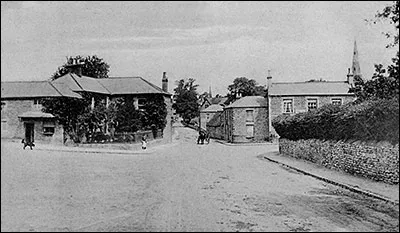
Dr. Kenneth I. Padget
From a conversation with Kate Bryce 2006
In practice in Burton Latimer from 1954 to 1990.

Doctor Padget
After training at
Dr. Padget’s house twice weekly (on Tuesdays & Fridays); the village hall at Cranford (where doctors and patients had to tramp across the field to reach it); in Dr. Kingsley’s house at Burton Latimer and at Lt. Harrowden in the sitting room of Mrs. Knowles (a patient) where the toilet was at the end of the garden and a tap in the yard. Originally the surgery at Lt Harrowden was opened in Mrs. Knowles’ house simply to write repeat prescriptions, but it quickly became common knowledge that the doctor called on a particular day at a certain time and thus developed into a surgery. Lt. Harrowden, Isham,
In the late 1950s a tramp died near the railway bridge on the A6. At that time it was the responsibility of the local council to bury vagrants who had met their demise in the parish boundary. The body was within the Burton Latimer boundary when found, but it was moved over the railway line to the
NHS Administration was governed by Regional Medical Board that held the funding. The Local Medical Committee would apply for funding for various projects in their area.
National Health Service came into being in 1948 and in Teaching Hospitals in 1949. Doctors had to work for the NHS for ten years before they could qualify for a pension. Because doctors were working until they were over 70 in order to qualify, and there were many ex-army doctors seeking employment, jobs were scarce at the end of the war. Of the 2-300 doctors attending an RAMC training camp only two had found employment.
In the 1950s it was quite rare to have the opportunity to see a caesarean section performed. Such an operation would attract every trainee in the hospital! Although great emphasis was put on diagnosis during doctor training, there were very few treatments available. In rural practices the main causes of deaths were diabetes and anaemia. Therefore the introduction of insulin and liver extract treatments were considered as important as the introduction of antibiotics. The next major step forward was the introduction of anti-depressants in the 1950s. It was not uncommon for Dr. Kingsley to perform circumcisions on the patient’s kitchen table. He had also performed tonsillectomies and delivered breach births at home. He continued these practices until the mid 1950s.
Kettering General Hospital was a cottage hospital with only four Consultants. Dr. H Voss (Pathology), Dr. T Partington (General Medicine), Dr. R Wigglesworth (Paediatrics) and Mr. T. Cullen (General Surgery). Orthopaedics were referred to the
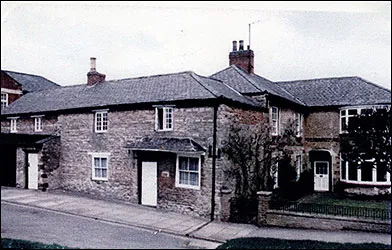
Osborne House, The Cross, High Street, from the 1930s
the home and surgery of several doctors (but not Dr.
Padget) before the first health centre was built in 1974.
By 1969 the population of Burton Latimer had grown quite rapidly and it became necessary to find more suitable accommodation than the tiny surgery in Osborne House. A purpose built Health Centre was opened on the High Street. It comprised of three consulting suites, Treatment Room, Health Visitor room, and staff accommodation. Dr. Jonathan Bird joined the practice when the Health Centre opened and Dr. Michael C Spencer joined in 1972. Dr. Padget became GP Trainer and the practice was part of the Vocational Training Scheme where qualified junior doctors would spend six months as part of their training.
When the Health Centre opened it was a showpiece for the County. The overseer of all the administrative and reception staff was Miss Pearson who was appointed by the Northamptonshire Family Practitioner Committee. The Administrator (part-time) was Mrs. Joan Woods. Reception staff were Mrs. Norah Matravers, Mrs. Kathleen Price, Mrs. Susan Harris, Mrs. Maureen Johnson.
Unusually, a man, Mr. Bob Goosey was appointed Health Visitor along with Miss E. Beaumont.
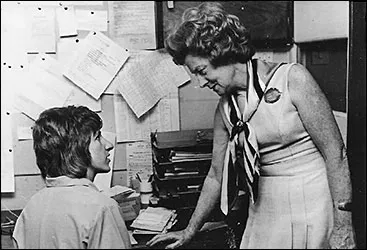
In 1974 the Minister of Health, Barbara Castle MP, visited the Health Centre in Burton Latimer. Reception staff on duty were Mrs. Sue Harris, Mrs. Kate Bryce. The full-time Administrator at the time was Miss Mary Downs.

|
Left: Barbara Castle, Minister of Health, talking to Kate Bryce when she visited Burton Latimer Health Centre in 1974.Right: Barbara Castle, Sir Geoffrey de Frietas, MP for Kettering and Dr. Ken Padget
|
|
Dr Padget closed the interview by saying “We like it here and Burton Latimer has been very kind to us” |