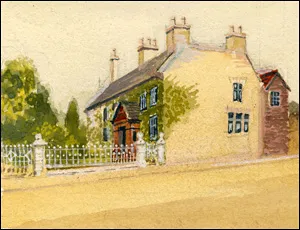
Osborne House (27 High Street)
Researched by John Meads 2007

Osborne House in the 1980s
The Wignells lived in the substantial limestone house which stands facing “The Cross”, the ancient name for the open area at the junction of High Street, Church Street and Meeting Lane, now the site of the town’s war memorial.

Prior to its occupation by the Wignell family, it had been the home of Robert Capps, a descendant of a family of butchers since the mid 1600s, who was also the owner of three houses and several acres of land.
Seen left is a part of the 1803 Enclosure Award map showing Robert Capps’ property at The Cross.

When Robert Capps died in 1820 the house, and probably the business, was purchased by Edward Wignell, born in Great Easton but who had come to Burton from Finedon. Following Edward Wignell’s death in 1862, his business was taken over by his son-in-law James Osborne who, it appears, eventually dropped the butchery side of the business to concentrate on farming until a few years before his death in 1908.
The photo on the left shows the window which would have been used when the house was a shop. As a reminder of the past, butcher’s hooks can still be seen at the front of the house
Much of the land belonging to his farms was rich in ironstone and James Osborne exploited this by leasing some it to the Burton Ironstone Company for iron ore extraction whilst still carrying on in business as a farmer until about 1900. He was also able to develop land in Meeting Lane where Osborne’s Row (at right angles to the street) and Osborne’s Terrace (parallel to the street) were built in about 1886.

James Osborne
in later life

Meeting Lane c1910. On the right is Osborne Terrace.
The first house in Osborne Row can be seen in front of
the Baptist Chapel.
Although the area where the house stood was known as Osborne’s Corner when he lived there, it was not until after his death that his former home became known as ‘Osborne House’, the first mention of it is to be found in a Kelly’s Directory of 1914 where it is given as the home of Herbert Ayres. He was the cashier at the Evening Telegraph, a prominent member of the Baptist Church, a parish, and later, an urban district councillor and its chairman in 1929.

Dr Albert Prince Kingsley
The house’s long association with Burton Latimer’s doctors began during the First World War.
An Evening Telegraph article dated March 1916 mentions an accident attended by a Doctor Byrne and then, in 1918, Dr. Edward Crofton Byrne is on the electoral register, living at The Cross with his wife Clytie. Kelly’s Directory of 1924 shows it as the home and surgery of Dr. Edwin Lloyd Warner. By 1928, his practice had been joined by Dr. Alan Strachan, but by 1931 his partner was Dr. F.K. Beaumont of Finedon.
After Dr. Warner left the town in 1934, Dr. Albert Prince Kingsley moved into Osborne House and lived there until his death in 1986. Until after the Second World War, Dr. Kingsley’s partner was Dr. Bell of Finedon and later Dr. Ken Padget, who eventually took over the practice when it moved to the newly built health centre in 1972. To read more about Drs Kingsley, Bell and Padget, click below.