Thatched Cottages
Copy of Douglas Ashby’s article in the Kettering “Evening Telegraph”, late 1960s, transcribed by Sally Crane
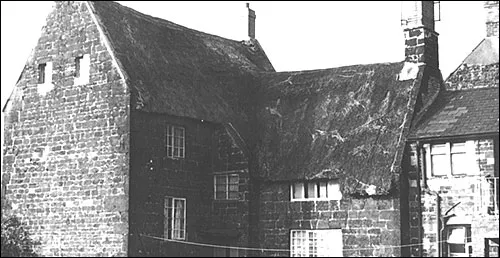
The former farmhouse whose demolition prompted the article
Burton Latimer will soon be losing one of its few remaining old thatched houses when the dilapidated building at the rear of the shops on the High Street is demolished.
News of this has prompted
At the turn of the century many of the old houses and cottages in Burton Latimer were still thatched, since then only six remain with their original roofing; the others that still stand having had their roofs replaced with tiles, slates or corrugated iron.
The fated 18th century house off the High Street, built of local ironstone, was originally a farmhouse and the building adjoining – now converted into two flats – was a large thatched barn that at one time was used by the British Legion for meetings. The fronts of the shops bordering the High Street were constructed out of the original stone wall enclosing the farm yard, also the large stone building now containing a grocery store, belonged to the farm. Entrance gates were by the present cake-shop and at the rear of the house from the fields beyond.


The rear of the building. The alleyway to the north of the property was known as “Barber’s Jitty”.
At the far end can be seen the present-day Kushboo Indian Restaurant.
When the photo was taken it was The Radiant Paint Company
Two other thatched houses remain on the High Street. The one opposite the original site of the War Memorial was at one time the home of a shoe-maker and this trade was carried on in premises at the rear.


The Thatched house opposite The Cross. First in 1940; second in the 1960s when the memorial was removed
as part of the realignment of the High Street-Church Street-Meeting Lane junction. The memorial has since
been restored to its original location. This house is and the Manor House are now the only two properties in
town which have been thatched throughtout their entire history.
The other cottage adjoins
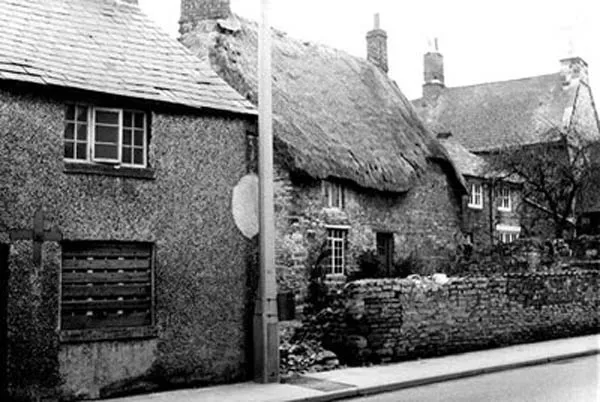
The cottage adjacent to Hilly Farm in the High Street shortly before it too was demolished.
Another interesting old stone house, partly thatched, stands at the end of
The shop in
Undoubtedly the most attractive of the remaining six thatched houses is the Manor House, which bears the date 1704 on the south gable. Standing as it does on its mediaeval mound adjacent to the ancient parish church, one has the impression that time has stood still and that this day and age is far removed from the 20th century. There must have been a residence on this site from as far back as Saxon times, as most certainly a Saxon church preceded the present

An aerial view taken in the 1960s of the Church
and Manor House
At one time the Manor House belonged to the Duke of Buccleuch and was used as a farm. In 1840 the land had to be walled off to prevent cattle straying into the churchyard. In later years it was the home of several curates, and in the 1920’s was extensively altered and restored, the north gable and entrance being added.
The pleasant house near the churchyard gate rebuilt in 1898, was originally thatched, and the old stone was used in the reconstruction. Also in
The great blizzard of March 1916 played havoc with thatched roofs. What we know as
The ruin adjoining the Wagon and Horses was originally a farm house, and the large barns to the rear were also at one time thatched. On the opposite side of the road three old cottages near to the present garage were demolished in the early 1930’s.
Several cottages in
In what was known as
A self-service store has replaced a row of old thatched cottages at the end of
What is still known as Amblers Cottage next to the Britannia Club was, in its day, the last house on that side of the road. Its thatched roof was replaced with tiles some years ago.
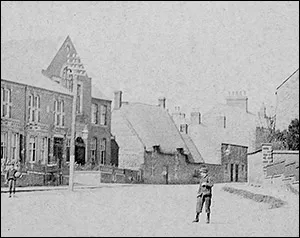
Ambler’s Cottage, next to the Britannia Club, in about 1910
Undoubtedly there were many other thatched properties in the village as it was then, which have long since passed from the scene. Today there is an air of sadness about a dilapidated old house that for many years played its part in providing a home for generations that have seen good times and bad, but the old order changeth, and as in previous years progress has to replace sentiment, the one consolation being that where it is possible to restore an old house it is being done.