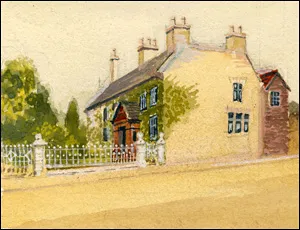
Windmill Cottages - Kennels: A Shanty Town for Dogs
Article from Sunday People, 2 October 1966
This ramshackle dump is run by a top breeder Animal Slums – a “People” enquiry which will shock every pet-lover, by David Jack and a team of investigators

is hardly a matter for pride. The broken-down wash-houses and latrines are
now her “kennels”.
In my opinion, it’s more of a Dog’s Dinner! A bit of a muddle. A bit of a mess.
The Act is not being administered with the vigilance and vigour that it should be.
“It is too vague in its standards, too loosely worded, leaving too much to varying interpretations by local councils.
And it is too narrow in scope.
I can’t imagine, for instance, that those who framed the Act can have really wanted it to exclude premises like those of Mrs Richard Harpur at the Barton Seagrave Kennels, near Kettering, Northants.
Mrs Harpur is proud indeed of the Borzois she breeds. “There isn’t a big kennels in England that hasn’t got some of my dogs’ blood,” she told me. “I was top Borzoi breeder of 1964.”
I was interested, therefore, to see what sort of accommodation was provided at such a renowned establishment.
There were dogs, it seemed to me, in every room of her house. I counted 15 and then gave up.
Luxury
Mrs Harpur went to the foot of the stairs and shouted — and Borzois came bounding down the stairs from the bedrooms.
No doubt for those fortunate Borzois it was the height of luxury to live in their keeper’s home.
But in the backyard were a collection of kennels and old sheds — containing more dogs.
Some of the seven sheds were not in use at the time of my visit, but four were falling to pieces. One had partly collapsed, loose boards having fallen off the side.
Another leaned at a drunken angle, its door hanging off the hinges.
The yard was strewn with dirty feeding bowls, old bones and scraps of gristle and fat covered in dust. And everywhere, heaps of excrement.
All the dogs looked healthy enough, although untidy and ungroomed.
But my surprise at these conditions was nothing to that on being shown Mrs Harpur’s other establishment, the Windmill Kennels, a mile or so away.
They were a row of derelict cottages with dogs in nearly every room, upstairs and downstairs. More dogs occupied ramshackle washhouses and lavatories outside.
Mrs Harpur recounted with pride how she had “snapped up” the cottages after they had been condemned by the local council. ” I decided they would make marvellous kennels,” she said. “Don’t you think it was a splendid idea? ”
Frankly, I didn’t.
Mrs Harpur told me that the dogs were exercised every day but clearly there were too many to keep out of doors for any length of time.
Sawdust was scattered on the floors, but in every room was an overpowering stench from soaked floorboards.
The dogs, shut up for long periods, had no option but to do their business on the floor.
In the best kennels I have visited, the dogs sleep under cover but have free access to open pens where they can obey the calls of nature and enjoy fresh air and sunlight.
Mrs Harpur, who employs an elderly man to look after her Windmill Kennels, boards other people’s dogs at £2 a week but does not have many clients.
Her main business is breeding and she does not have to be licensed or to have her premises regularly inspected.
Obviously Mrs Harpur, who has been running kennels for 41 years, is genuinely fond of animals yet sees nothing wrong with her two establishments.

fireplace and wood floors of a condemned cottage at
Mrs Harpur’s “Windmill Kennels”.