The Barlows in Burton Latimer
Article compiled by John Meads.
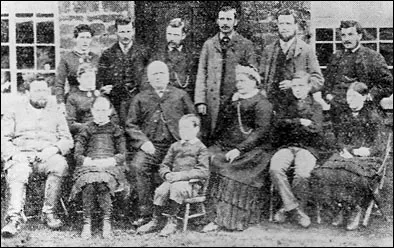
The Barlow Family at Rothwell
The Barlow family, which played a major role in the development of retail trade and business in Burton Latimer in the second half of the 19th century and first half of the 20th century, originated in Rothwell. John Barlow, a builder, moved from Rothwell in the late 1860s and his cousin Charles, after serving an apprenticeship at Ernest Lewin’s Burton Latimer shop at The Cross, bought it and moved here about the time of his marriage to Deborah Sharpe in 1877.
John Barlow 1851 - 1903
In 1870, John Barlow married Sarah Ball, the daughter of a Burton Latimer mason, Thomas Ball. They went on to have eight children:
|
1871 Sarah – married Arthur James Cox in 1890 1875 Arthur John – married Rose Eliza Heasman in 1909 1876 Thomas Samuel – married Elizabeth Jane Moore in 1912 1880 Eliza – married Edmund Geagan in 1904 1881 Mary Ann – died in 1883 1885 Maud Mary – married George Worley in 1904 1887 Alfred 1890 Sydney Albert |
In the 1901 census, John was a self-employed builder and his two eldest sons were bricklayers.
Charles Barlow 1857 - 1923
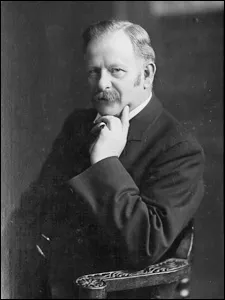

Charles Barlow
Deborah Barlow
In 1877, at St. Mary’s Parish Church, Charles married Deborah Maria Sharpe. Charles and Deborah had six children:
1879 Frank – butcher – married Favilla Cook in 1903 – Died 1948.
He had four sons:
Frank Geoffrey born 1904 – married Dorothy M Cox in 1930
Ralph born 1906 – married Constance Evelyn Goode in 1931. Died 1989.
Charles Stanley born 1908 – managed a farm, then moved to
Philip W. born 1917 – married Cynthia Goode 1953
1880
1882 Alfred – grocer – married Edith Elizabeth Quincey, a milliner in 1909; both of them ran adjacent shops in the High Street
1886 Arthur Edwin – butcher – married Betsy A Stimson 1910 – moved to
1888 Harold – married Mildred Westley in 1916
1891 Daisy – married Frederick Poll in 1919 died in middle-age.

|
Barlow’s shops c1932 – Arthur Gilbey on left
|
In the parish register at the time of his marriage, Charles Barlow was described as a grocer and draper, his father a builder and Deborah’s father, William Sharpe, was described as a grocer. William Sharpe and his family lived in the High Street in an old farmhouse, to which a shop had been added, the garden and orchard of which were later used as the site for building the school. In 1881, Charles and Deborah were living at The Cross where his family were to continue in business until the early 1960s. Some time after Deborah’s father’s death, Charles took over the shop from her mother and it was known as Barlow’s No: 2 Store. It was later to become a dairy.
Click on the Play symbol below to hear Jack Newman talk about Charles Barlow’s dairy
(You may need to download the Quicktime Player for this and other sound clips)

Charles Barlow’s business premises at The Cross included a butcher’s shop and slaughterhouse operated by his eldest son Frank and a grocery and drapery operated by himself and later by his son Alfred and his wife Edith. His interests expanded to include farming, brick making at Croxen’s Yard and ironstone extraction on the Finedon/Burton Latimer boundary. A few yards away from his premises at The Cross, Charles’ brother Henry, who had become a baker and confectioner in Kettering, opened a cake shop in the early 1920s, managed by his son.
Click on the Play symbol below to hear Jack Newman talk about Charles Barlow’s wider business interests
All the time his businesses were growing, Charles Barlow was heavily involved in local government. This started with membership of the Board of Guardians from 1881, membership of the Parish Council from when it was created in 1894, membership of the Kettering District Council and also
He was chairman of the board of management of the
All these achievements were described in a beautifully illustrated Tribute in the form of a leather-bound book which was circulated around Burton Latimer in 1914 and was signed by over 500 people.
He started his married life living at The Cross, probably over the shop, but moved to The Yews in

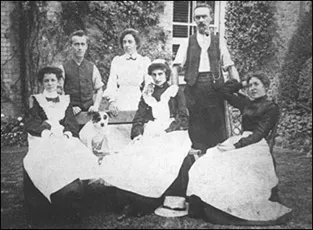
The Yews 1914
Staff at The Yews c1916
Following the death of Deborah in 1920, he presented an organ to the Baptist Chapel in her memory. There is also a memorial in the Chapel, placed there by his fellow deacons to record his work for many years as the Church’s treasurer. (Click below to read about Charles Barlow’s election to the County Council in 1892)